This tutorials looks at the OSI model and describes how it relates to real-world networking. It also examines how common network devices relate to the OSI model. Even though the OSI model is conceptual, an appreciation of its purpose and function can help you better understand how protocol suites and network architectures work in practical applications.
OSI Seven Layer Model
As shown in Figure 1, the OSI reference model is built, bottom to top, in the following order: physical, data-link, network, transport, session, presentation, and application. The physical layer is classified as layer 1 and the top layer of the model, the application layer, as layer 7.
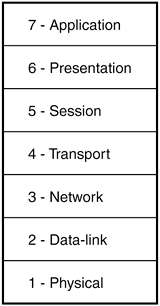
The OSI seven layer model.
Each layer of the OSI model has a specific function. The following sections describe the function of each layer, starting with the physical layer and working up the model.
